

Quick Breakdown
-
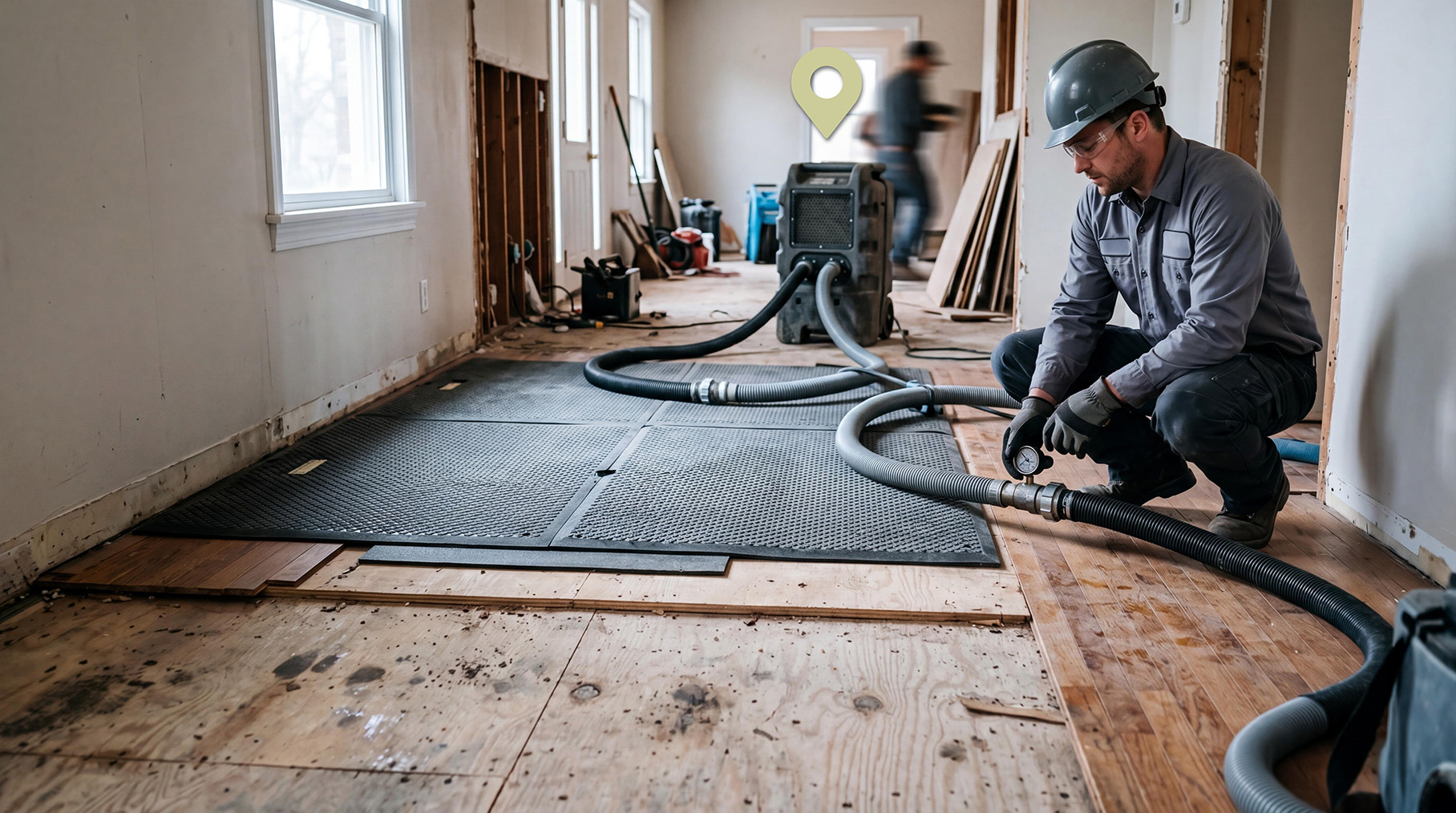
Equipment gets unloaded fast on a restoration job and keeping track of it can be difficult when items may remain at a location for days or weeks.
-
GPS asset trackers can be used to tag tools and equipment with automated scheduled reports to monitor inventory.
-
Asset tracking helps you eliminate equipment hoarding, provides documentation for insurance claims, and flags equipment for scheduled maintenance.
There are many priorities begging for attention when field technicians arrive at a restoration job, which is typically why gear often gets unloaded quickly without much visibility into when or where it goes.
To help with this issue (without slowing down the crew), most successful contractors rely on tracking tech to ensure equipment is doled out efficiently and ultimately makes its way back to the truck when the job is over.
What's the difference between GPS tracking and asset tracking?
GPS fleet tracking and asset tracking solve different problems. Vehicle GPS gives dispatchers a live view of where trucks are in real time.
Asset tracking works differently. Tags get attached directly to individual tools like air movers or moisture meters. These are built to be durable and easy to mount, but they don't need constant power, so they report periodically instead, usually once or twice a day, to save battery life.
That periodic reporting is fine for most equipment, but it's not enough if a driver leaves a piece of gear behind and needs to find it fast. Linxup's long-term asset tracker solves that with a recovery mode: once triggered, it pings every ten minutes instead of once a day, so a driver isn't waiting around for a dehumidifier to check in on its own schedule.
How does asset tracking solve day-to-day problems on a job site?
Reliable asset tracking, using the right tools instead of trusting everything to memory, manual entry or a whiteboard, sidesteps three problems that show up on almost every restoration job.
1. Tracking eliminates equipment hoarding
Asset tracking stops equipment hoarding by showing managers what's actually deployed versus what's sitting unused in a truck. When a natural disaster or other regional event hits and equipment gets scarce, technicians sometimes hold onto extra air movers or meters just in case they need them for the next job. That leaves the office in the dark, thinking the company is short on gear when units are actually idle in a parking lot somewhere. Live tracking gives shop managers full visibility into what's deployed versus what's sitting idle, so they can reallocate equipment instead of buying more.
2. It provides easy documentation for insurance claims
Asset tracking gives you a timestamped record of exactly when equipment arrived at and left a job site, which is the proof adjusters ask for. Insurance adjusters need to verify drying logs and approve invoices, and that requires documentation of how long specific equipment was actually running on-site. Having that record ready to go speeds up reimbursement, backs up your billing, and cuts down on payment disputes with carriers.
3. Tracking flags equipment for maintenance and testing
Tracking software flags equipment for maintenance automatically, based on usage hours, before a tool fails on-site. Moisture meters and thermal cameras need regular calibration, and dehumidifiers and air scrubbers need routine filter changes and safety testing. Instead of waiting for a tool to fail mid-job, the system alerts shop managers once a unit hits its service threshold, so it can get routed back to the warehouse for maintenance without pulling it off a job unexpectedly.
How to roll out equipment tracking without disrupting the crew
Before rolling out, decide what actually needs a tracker. You don't need one on every tool in the truck. Focus on equipment that's expensive to replace, easy to leave behind, or hard to visually account for at a glance, things like air movers, dehumidifiers, and thermal cameras. Hand tools and smaller gear usually aren't worth the cost or the hassle of tagging individually.
Assign responsibility by vehicle. Instead of holding every technician accountable for every piece of company equipment, assign responsibility by the vehicle. Make the lead driver or crew chief responsible for the specific inventory of their truck.
Geofence your warehouse and storage yards. A geofence is a virtual boundary drawn around a geographic area within the tracking software. Geofence your main office, secondary warehouses, or equipment yards, and the system logs equipment back into central inventory automatically the moment a truck drives through the gate.
Establish a gate-out, gate-in routine. Have drivers check their tracking app before leaving the yard (Gate-Out) to confirm all assigned tools are loaded, and again at the end of the day (Gate-In) to confirm everything made it back.
Define a clear, no-fault protocol for missing alerts. Set a clear process for when an item goes missing. A transparent, low-friction reporting habit ensures technicians use the system honestly rather than trying to bypass it out of frustration.
Frequently asked questions about equipment tracking for restoration contractors
How often do asset trackers report their location?
Most report once or twice a day. Linxup's long-term asset tracker has a recovery mode that pings every ten minutes if you need to locate a specific item fast.
Can asset tracking data be used for insurance claims?
Yes. It provides a timestamped record of when equipment arrived at and left a job site, which speeds up insurance reimbursement and reduces payment disputes.
Do I need to track every tool, or just high-value equipment?
No. Focus on equipment that's expensive to replace, easy to leave on-site by accident, or hard to visually account for, things like air movers, dehumidifiers, and thermal cameras. Smaller hand tools usually aren't worth tracking individually.
By combining vehicle GPS with equipment trackers, restoration contractors can eliminate the guesswork of inventory management, easily back up their insurance claims and keep their field teams focused entirely on the recovery work at hand.
Figuring out which equipment is worth tracking is the first step. If you want to talk through what that looks like for your fleet, Linxup's team can walk you through it.