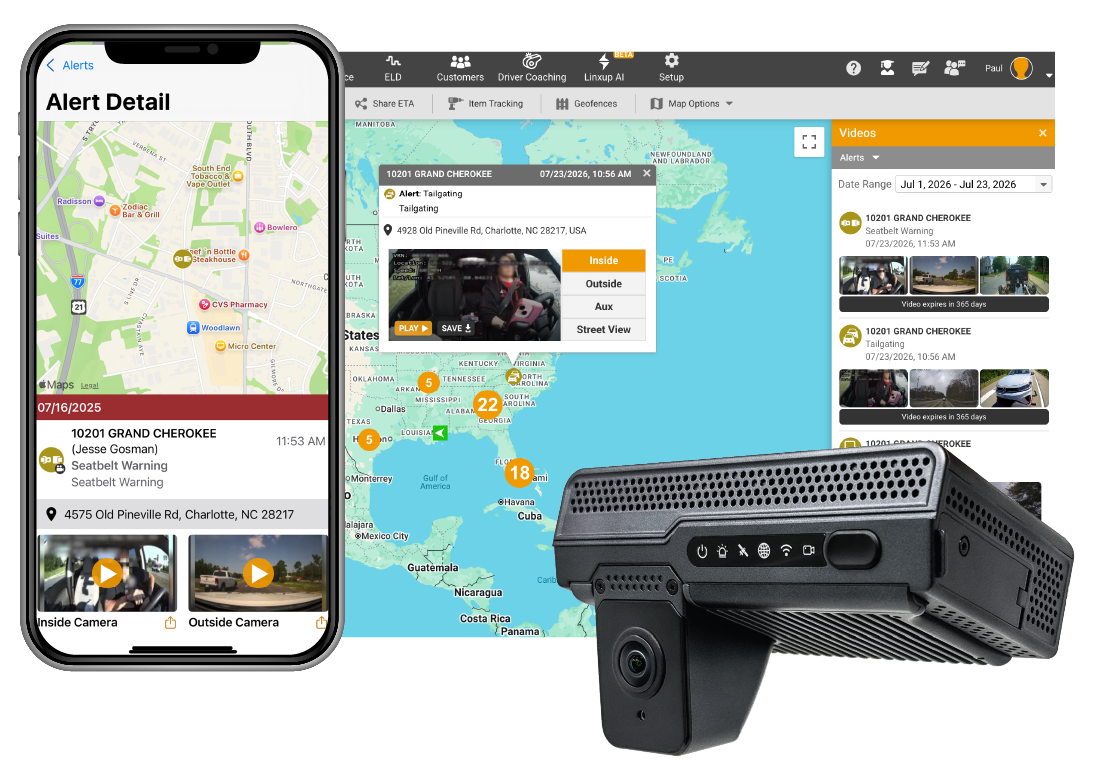
Linxup delivers fleet management software that's the right fit for growing small and mid-sized businesses. Get powerful GPS fleet tracking, AI dash cams, equipment tracking, and tool tracking in one easy-to-use desktop and mobile platform, backed by live U.S.-based support.
In the office or on the road, Linxup delivers critical visibility into every vehicle, driver, asset, and tool — so you spend less time chasing information and more time running your business.
Matt Scheff
Father and Son Pest and Lawn Solutions, Navarre, FL
Linxup fleet tracking gives you the information and insights you need to maximize your fleet’s up-time, coach your drivers into safer habits, provide key real-time service updates to your customers, and improve fleet efficiency.
LinxCam gives you the video footage you need to identify and coach problem behavior and protect your business in the event of unfounded accident claims. In-cab driver notifications inhibit risky behavior.
Linxup's GPS tracking devices provide affordable monitoring of your critical assets, ensuring you know their exact location while protecting against theft and unauthorized use.
Eliminate the cost and hassle of lost, stolen, and forgotten tools with Linxup Tool Trackers. These small, affordable trackers easily affix to any kind of tool, so you’ll always see each tool’s last known location.
LinxCam Rear Vision adds rugged, weather-rated, rear-facing cameras to the LinxCam dash cam — closing the blind spot that costs fleets claims, time, and customer trust. See front and rear views in the same app.
Linxup GPS vehicle tracking and LinxCam AI dash cams make it easy to spot risky driving, coach better habits, and protect your team from accidents — and your business from unfounded claims.
Why Linxup?
Since 2004, Linxup has focused on one thing: providing full featured fleet and equipment tracking that works for small and mid-sized businesses. Linxup is not a "budget" solution or a stripped down enterprise system. It's built from the ground up to deliver the power you need without the complexity you don't. Real-time GPS, AI dash cams, and asset tracking — built to be simple to set up, easy to use, priced for a business your size, and backed by live, U.S.-based Customer Success agents who know your business.
What does Linxup do?
Linxup delivers full-featured real-time vehicle tracking, AI dashcams, rear-facing cameras, asset tracking, and tool tracking in one powerful, easy-to-use view — specifically designed for the needs of small and mid-sized businesses with vehicles, tools, and equipment in the field.What industries does Linxup serve?
Most Linxup customers are in HVAC, Plumbing, Landscaping, Pest Control, Construction, Delivery, and Transportation. But we serve customers across the spectrum of on-the-go businesses, from non-emergency medical services to airport management.Where is Linxup based?
Linxup is based in Chesterfield, MO, and also has an office in Charlotte, NC. All product development and customer onboarding and support happens in our Chesterfield office. We source our hardware from US companies wherever possible.What does Linxup cost?
Linxup GPS vehicle tracking costs $25 per vehicle per month. LinxCam dash cam service is $25 per vehicle per month. LinxCam Rear Vision auxiliary camera service is $15 per vehicle per month. Asset tracking is $15 per tracker per month. Volume and bundle pricing is available. Hardware costs vary depending on length of contract. For example, a Plug-in GPS vehicle tracker costs $69.99 on a no-contract plan, $29.99 with a 2 year contract, and free with a 3 year contract. A LinxCam rep can work with you to determine the best program for your needs at a price that works for your business.Don't take our word for it, schedule a demonstration and we'll show you live what Linxup can do for your business.
No. Vehicle GPS and asset tags for trailers and equipment show up in the same Linxup dashboard.
The best GPS tracking device depends on what you're tracking and what business problems you're trying to solve.
If you manage company vehicles, look for a solution that provides real-time GPS tracking, driver behavior monitoring, maintenance alerts, and reporting to help improve productivity, safety, and operating costs.
If you're tracking trailers, heavy equipment, or other valuable assets, prioritize long battery life, durable weather-resistant hardware, and flexible installation options.
Beyond the hardware itself, evaluate the complete tracking platform. A business-grade GPS solution should include:
For many businesses, the software and support ultimately deliver more value than the tracking device alone.
Linxup offers a range of GPS tracking devices for vehicles, trailers, and equipment, backed by an easy-to-use fleet management platform that helps businesses reduce costs, improve visibility, and make better operational decisions. Whether you manage five vehicles or several hundred assets, Linxup provides solutions that scale as your business grows.
GPS satellites send radio signals to a connected GPS device within a vehicle or asset, allowing it to calculate its precise location.
The GPS device within the vehicle or asset sends those location coordinates and other data like movement and speed to a cellular tower when it's within range.
Linxup servers receive the data, analyze it, and gain insights like location history and alerts. We send the data, including location history, alerts, and driver behavior, to our customer portal, where you can access it.
A fleet dash cam is a professional-grade camera system built specifically for commercial vehicle operations. While a consumer dash cam is typically a single-channel device that records locally to an SD card, fleet-grade systems are engineered for centralized management across multiple vehicles simultaneously.
The most fundamental operational difference is connectivity. Consumer cameras require physically retrieving a memory card and manually reviewing footage — a process that can take 12–24 hours from incident to review. Fleet dash cam systems connected via LTE or 5G upload critical event footage automatically, often within seconds, allowing managers to access, share, and act on footage from any location without touching the vehicle.
Fleet systems also integrate directly with GPS tracking and telematics platforms, correlating video with vehicle speed, location, and driving behavior data. This turns a camera from a passive recorder into an active management tool — surfacing coaching opportunities, flagging unsafe patterns, and providing timestamped, GPS-corroborated evidence that holds up in insurance disputes and litigation.
Configuration options have expanded significantly. Front-facing (single-channel) cameras are the most common starting point, capturing road conditions, collisions, and near-misses ahead of the vehicle. Dual-channel systems add a driver-facing lens to monitor attentiveness and in-cab behavior. Multi-channel configurations — covering front, rear, sides, and interior — are common in high-liability industries such as construction, logistics, and public transit.
For SMB field service fleets, the practical case for fleet-grade hardware comes down to three things consumer cameras cannot provide: centralized cloud management across all vehicles, automatic event-triggered upload with no manual retrieval, and integration with fleet management software for coaching and reporting workflows.
This is one of the most frequently asked questions, and it deserves a careful answer because the relationship between dash cams and insurance savings is real but more nuanced than vendor marketing often suggests.
The commercial auto insurance environment makes this conversation increasingly urgent. In 2024, commercial auto premiums experienced some of the highest increases in recent years, with rates rising between 9% and 9.8% in the first two quarters. Insurers have reported combined loss ratios above 100% for 12 of the past 13 years, paying out more in claims and expenses than they earned in premiums. In 2024, 135 corporate lawsuits resulted in a nuclear verdict — a jury award exceeding $10 million — a 52% increase over 2023, with total awards reaching $31.3 billion. These dynamics are driving underwriters to scrutinize fleet risk profiles more aggressively at renewal. CBIZSambasafety
Dash cams address this in two ways. First, some insurers offer direct premium credits for verified camera installations, particularly for fleets that also share safety performance data. Second — and more reliably — dash cams reduce the cost of individual claims by providing clear evidence of fault, enabling faster resolution and reducing the risk of being wrongly assigned liability.
An FMCSA study found that in-cab safety cameras reduced safety-related events by 38% over 13 weeks. When adding driver awareness alerts and coaching functionality, dash cams reduced safety-related events by 52%. Fewer incidents translate directly to a better claims history, which is the strongest lever fleet operators have at policy renewal.
The recommended approach: before purchasing, contact your commercial auto carrier and ask what documentation they require to qualify for premium credits or program discounts. Premium outcomes vary by carrier, fleet size, and risk profile. Do not rely on a vendor's projected savings figures without validating them with your broker.
GPS and Bluetooth tracking technology can be applied to a wide range of asset types, broadly grouped into two categories:
Powered assets (tracked via hardwired or OBD GPS devices):
Unpowered assets (tracked via battery-powered GPS or Bluetooth tags):
The right technology depends on the asset type. Powered equipment typically supports real-time GPS with engine-hour tracking. Unpowered or small assets are better suited to long-life battery GPS trackers or Bluetooth tags that register location when in range of a connected device. Linxup offers both GPS vehicle trackers and Bluetooth asset tags, allowing businesses to track mixed fleets and equipment inventories from a single platform.
There's no single industry-wide number — discounts vary by carrier, program, and how consistently a fleet participates — but the trend is toward real, negotiable savings rather than a flat rebate. A 2023 survey of insurance professionals found 72% of commercial insurance companies already offer or plan to offer a telematics-based product, though 65% of commercial carriers reported some level of telematics adoption at that time, with the largest share still in early stages — meaning the size of your discount often depends on how mature your specific carrier's program is, not just on your driving data. More recently, a January 2026 Insurance Journal piece citing SambaSafety's 2025 Telematics Report noted that 60% of insurers now use telematics across their risk control teams, with a majority of the top 50 commercial auto insurers offering or subsidizing telematics as part of their risk programs. This matters for the "how much" question because it confirms the eBook's framing: telematics gives you leverage in a renewal negotiation, but the actual dollar discount is something you have to ask your specific broker and carrier about — not a number Linxup or any vendor can promise. Insurance Journal, 2023
Yes. LinxCam Rear Vision adds a third camera to LinxCam, covering backing incidents and loading activity in addition to the road and cab.
The short answer, based on both Linxup's own survey data and third-party research, is that the tools correlate strongly with fewer claims and better outcomes — though it's worth being precise about what "reduce accidents" means versus "help manage the aftermath of accidents," since those are two different (if related) claims.
Among field-service employees Linxup surveyed who use fleet safety tools, 64.3% reported experiencing safer driving habits as a direct benefit, 52.5% reported better driver accountability, and 50.2% specifically cited fewer accident claims. A smaller share — 25.5% — pointed to easier dispute resolution, and 23.5% cited protection against fraud. On the specific question of whether GPS or dash cam footage has actually changed the outcome of an accident or insurance dispute, 43.8% said yes, it worked in their favor, with another 13.9% saying the outcome was mixed; only 3.4% said they don't use these tools at all.
That tracks with why insurers care about this category in the first place. Commercial auto insurance underwriting is a forward-looking risk assessment — carriers look at safety policies, training programs, and increasingly, telematics data, not just past claims history — and documented safety programs with telematics reporting are becoming a more standard part of that underwriting checklist. A 2023 industry survey found 72% of commercial insurance companies already offered or planned to offer a telematics-based product, and more recent reporting citing SambaSafety's 2025 Telematics Report put the share of insurers using telematics across risk-control teams at 60%. That doesn't mean every carrier offers a specific discount for having GPS tracking or dash cams — the size of any discount is something you'd need to confirm directly with your broker — but it does mean fleets running these tools increasingly have real leverage in a renewal conversation.
On the fatigue/behavior side specifically, driver behavior monitoring and real-time in-cab alerts are designed to catch and correct issues like speeding, harsh braking, and following distance before they become an incident — which is a genuinely preventive mechanism, distinct from dash cams, which primarily document what happened after the fact. GPS/telematics also supports route review and identifying high-risk zones or excessive idling, which contributes to overall risk reduction even though it's not directly "accident prevention" in the same sense.
One important nuance for how you evaluate this claim internally: 72% of the employees surveyed said their company currently uses dash cameras in work vehicles, but that also means over a quarter of these fleets don't yet — so if you're building an ROI argument for adoption, the more defensible framing is "the majority of comparable fleets already use this and report concrete benefits," rather than an unqualified claim that dash cams universally reduce accident rates, which isn't a claim the data actually supports on its own.

We're here to help you!
BLOG
We stuff our blog with ideas, tips, and news about running your service business.