

Quick Breakdown
-
AI dash cams keep construction sites safe by detecting unsafe driving or other potential hazards.
-
Video and GPS give supervisors a clear picture to review incidents, answer questions, and prevent repeat problems.
-
Safety insights help crews and supervisors build better habits and make job sites safer.
Construction sites move fast, and threats to crew safety can develop quickly. According to BLS data, transportation incidents alone caused nearly a quarter of all construction fatalities in 2023, while workers struck by vehicles accounted for more than a third of struck-by deaths. Any tools built to monitor potential risks better be able to keep up.
Traditional dash cameras record footage that can be reviewed after an incident, leaving managers to react after something has already gone wrong. The real time detection that comes with AI dash cams alerts vehicle operators of potential hazards and gives them an opportunity to respond before an accident occurs.
AI-powered dash cams support jobsite safety, acting as an extra set of eyes monitoring vehicles and equipment, preventing accidents, documenting incidents and reinforcing important daily routines.
How AI dash cams spot hazards on construction sites
Whether it’s a worker stepping into a blind spot, a truck backing toward a crowded area, or a load of raw materials shifting unexpectedly, construction site hazards tend to unfold in a matter of seconds. Strict safety procedures can help prevent most of these incidents, but construction work tends to always include a certain degree of unpredictability — one requiring on-site tools that can safeguard workers and equipment in moments of potential harm.
Linxup’s AI dash cams recognize sudden following-distance changes and other unsafe conditions, including driver cell phone usage, from moment to moment. On any construction site, a split-second alert might prevent a collision with a forklift or stop a dump truck before it clips a barricade.
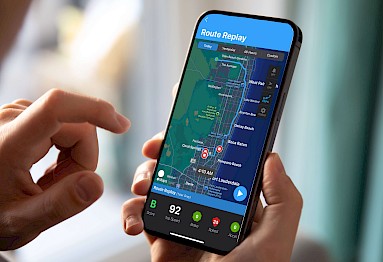
Linxup’s safety tools also benefit supervisors in need of real-time asset management. On-board GPS quickly pinpoints vehicles or equipment and prevents losing track of important tools.
Clear, useful footage for incident reviews
The noise and motion of a busy jobsite makes for fuzzy memories and easy-to-miss details. AI dash cams capture high-quality footage from both inside and outside the cab so teams can review exactly how events played out.
Because Linxup’s system recognizes key behaviors like sudden braking, swerving, or a close approach to pedestrians, it can quickly resolve key questions surrounding an accident:
• Did a spotter signal correctly?
• Was a worker inside a restricted zone?
• Did a truck have enough clearance?
When teams can see the full story, it’s easier to update protocols, rearrange equipment, or change vehicle pathways to prevent repeat incidents.
How AI dash cams reinforce driver coaching
Safety training usually happens in scheduled sessions, but risky moments happen every day. AI dash cams give crews more consistent touchpoints for improvement by highlighting patterns over time.
For example, if a driver frequently backs up without a complete stop or tends to take sharp turns near foot traffic, the system can surface these trends as specific, helpful notes instead of vague reminders to “be more careful.”
These insights also support supervisors who may not always have visibility across large or multi-site operations. They can track whether new workers are adapting well, whether certain areas produce more risky maneuvers, or whether recent layout changes are working as expected.
Importantly, this type of coaching doesn’t require micromanagement. Access to safe operations data gives workers the chance to self-correct and build safer routines on their own terms.
Reducing risk across job sites
Construction sites will never be entirely risk-free, but they can be far more predictable. AI dash cams help stabilize the environment by reducing unknowns. Patterns in the data can reveal issues no one noticed — such as delivery trucks consistently idling too close to walkways, or heavy equipment cutting through high-traffic areas during shift changes.
With these insights, safety managers can rearrange vehicle paths, adjust schedules, or redesign staging areas before problems escalate. On multi-site operations, supervisors can also compare patterns across crews and locations, catching a recurring risk at one site before it shows up at another.
Clearer visibility also supports communication with subcontractors, who may only be on-site for short stretches and might not know the full layout or flow of the site. When everyone follows the same expectations and hazards are easier to spot, the entire job becomes smoother — and workers can focus on their tasks without wondering whether the next corner hides a moving piece of equipment.