Increase Driver Safety
Reduce Risk and Liability for Your Business
Safe Driving Makes Business Sense
Coaching your drivers to safer driving habits not only reduces your risk as a business owner, it can save you money. Linxup's real-time GPS tracking system gives you a host of tools for improving driver safety, including:
- Real-time alerts or summary notifications for unsafe driving behaviors.
- Configurable safety scores for individual drivers and your entire fleet.
- Simple and transparent scoring with clear, research-backed metrics.
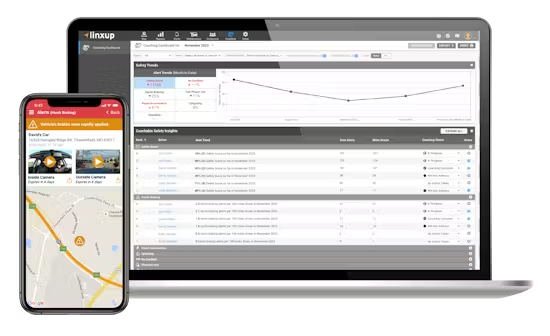
- Driver Coaching Dashboard highlighting safety trends and insights.
- Driver Coaching notes, making it easy to document conversations with drivers and track progress.
Driver Coaching Dashboard
The Driver Coaching Dashboard showcases safety trends over time so you can get a high-level snapshot of your team’s performance.
"The setup process is simple and intuitive. This is a useful tool for addressing performance issues with my team."
Anthony Pipia
Operations Manager, All Phase Electric Service of FL, Inc.
Target Risk. Coach with Purpose. Drive Results.
Driver Coaching Sessions help you target high-risk or top-performing drivers, schedule personalized sessions based on driving trends and alerts, and track progress with performance updates. Share “Driver Notes” via email to keep drivers informed and engaged, supporting consistent feedback and improved behavior over time.
Receive Real-Time Alerts or Summary Notifications
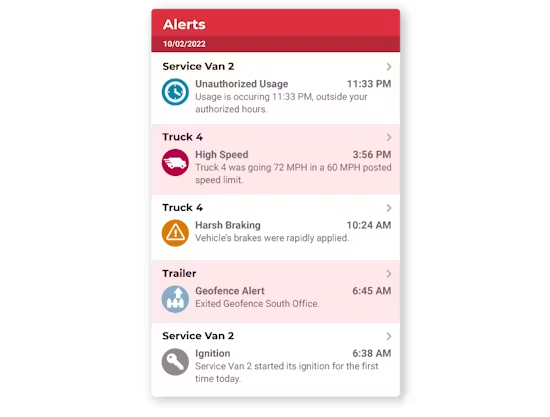
With our vehicle tracking devices and dash cameras, Linxup gives you real-time alert notifications through the mobile app or summary notifications through e-mail or text when unsafe driving occurs, including:
- Speeding
- Speeding in a Geofence
- Harsh braking
- Rapid acceleration
- Unauthorized hour usage
- First ignition of the day
- Geofence entries or exits
- Device tampering and no GPS signal
- Excessive idling
- Potential Impact
- Phone in use
- Tailgating
- No seat belt
Let the Data do the Talking
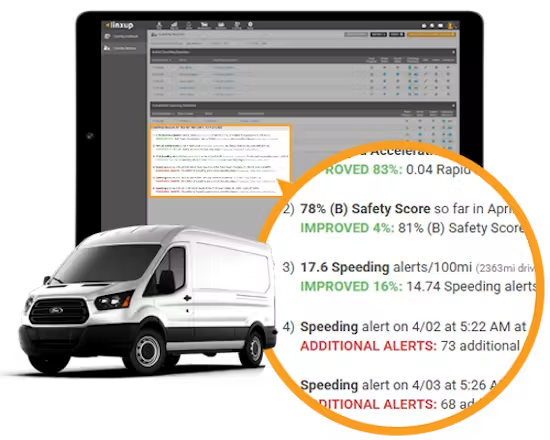
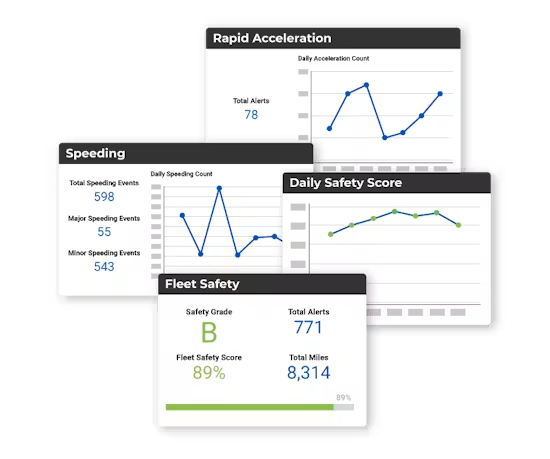
Linxup's Driver Safety Report Card allows you to track driver safety behavior over time and pinpoint areas for improvement. At a glance, you can see:
- A daily performance score for each driver
- A grade for each driver’s overall performance
- An overall safety grade for your entire fleet
FAQs About Driver Safety
Below are the most common questions we hear about driver safety related to fleet tracking, dash cameras, and ELD.
The short answer, based on both Linxup's own survey data and third-party research, is that the tools correlate strongly with fewer claims and better outcomes — though it's worth being precise about what "reduce accidents" means versus "help manage the aftermath of accidents," since those are two different (if related) claims.
Among field-service employees Linxup surveyed who use fleet safety tools, 64.3% reported experiencing safer driving habits as a direct benefit, 52.5% reported better driver accountability, and 50.2% specifically cited fewer accident claims. A smaller share — 25.5% — pointed to easier dispute resolution, and 23.5% cited protection against fraud. On the specific question of whether GPS or dash cam footage has actually changed the outcome of an accident or insurance dispute, 43.8% said yes, it worked in their favor, with another 13.9% saying the outcome was mixed; only 3.4% said they don't use these tools at all.
That tracks with why insurers care about this category in the first place. Commercial auto insurance underwriting is a forward-looking risk assessment — carriers look at safety policies, training programs, and increasingly, telematics data, not just past claims history — and documented safety programs with telematics reporting are becoming a more standard part of that underwriting checklist. A 2023 industry survey found 72% of commercial insurance companies already offered or planned to offer a telematics-based product, and more recent reporting citing SambaSafety's 2025 Telematics Report put the share of insurers using telematics across risk-control teams at 60%. That doesn't mean every carrier offers a specific discount for having GPS tracking or dash cams — the size of any discount is something you'd need to confirm directly with your broker — but it does mean fleets running these tools increasingly have real leverage in a renewal conversation.
On the fatigue/behavior side specifically, driver behavior monitoring and real-time in-cab alerts are designed to catch and correct issues like speeding, harsh braking, and following distance before they become an incident — which is a genuinely preventive mechanism, distinct from dash cams, which primarily document what happened after the fact. GPS/telematics also supports route review and identifying high-risk zones or excessive idling, which contributes to overall risk reduction even though it's not directly "accident prevention" in the same sense.
One important nuance for how you evaluate this claim internally: 72% of the employees surveyed said their company currently uses dash cameras in work vehicles, but that also means over a quarter of these fleets don't yet — so if you're building an ROI argument for adoption, the more defensible framing is "the majority of comparable fleets already use this and report concrete benefits," rather than an unqualified claim that dash cams universally reduce accident rates, which isn't a claim the data actually supports on its own.
Yes. The Apollo ELD provided by Linxup includes built-in alerts that notify drivers as they approach their Hours of Service limits, giving them time to plan stops and avoid violations before they occur.
How the alerts work:
- Visual indicators — the Apollo home screen displays three real-time "donut" gauges showing time spent in each duty status: driving, on-shift on-duty, and on-cycle on-duty. Each gauge turns yellow as the driver approaches the limit and red when the limit is near.
- Violation warnings — the app displays the driver's closest possible upcoming violation directly on the main screen.
- Advance notifications — the ELD triggers a pop-up alert one hour before a potential violation and again thirty minutes before the limit is reached, giving drivers two advance warnings per limit.
Additional planning tools built into the app:
- Recap summary — drivers can tap their on-cycle gauge to see exactly how much on-duty time will be returned when their 7th or 14th day resets, helping with weekly route and rest planning.
- Deferral option — where regulations permit, drivers can split off-duty time across two consecutive days using the in-app deferral feature.
- Adverse conditions — an optional setting activates when a driver is nearing shift limits under qualifying adverse driving conditions, per FMCSA guidelines.
These features are built directly into the Apollo ELD app and function automatically once the driver is logged in and connected to the ECM device. No manual configuration is required by the driver.
For more details, visit the Linxup ELD FAQ or contact Linxup ELD support at 877-732-4980.
Based on the employees Linxup surveyed across companies that operate a commercial fleet, GPS vehicle fleet tracking is by far the most widely used safety-adjacent technology, at 76.4% adoption, followed by dash cameras at 62.5%, rear-facing cameras at 50.2%, and 360-degree cameras at 36.3%. Further down the list: digital vehicle inspections (30.7%), driver coaching tools (27.3%), in-cabin AI safety alerts (19.9%), and First Notice of Loss/claims reporting tools (15%). Only 4.5% of respondents said they interact with none of these technologies at all.
When asked which single technology delivered the most value to their day-to-day work, GPS fleet tracking again led at 30.6%, with dash cameras a distant second at 20.4%. That's a useful distinction — broad adoption doesn't necessarily map onto perceived value, and it suggests that even among fleets running several safety technologies simultaneously, GPS/telematics tends to be the backbone employees rely on most, with dash cams and other tools functioning as complements rather than replacements.
Rather than trying to adopt every category listed above at once, match specific tools to your fleet's specific priorities. Backing collisions point toward dual-facing cameras, proximity sensors, or training modules; distracted driving points toward AI-powered dash cams with real-time alerts; driver fatigue points toward hours-of-service monitoring. It's also common for fleets to consolidate several of these categories — fuel reports, DVIRs, maintenance tracking, CSA scores — into a single dashboard rather than maintaining a separate login for each function, which reduces the operational overhead of running a safety program day-to-day.
On the monitoring side specifically: 81.2% of the employees surveyed said their employer actively and regularly uses GPS or telematics to monitor driving behavior or address risky habits, with another 11.4% saying it's used occasionally. Only 4.3% said their employer doesn't use these tools at all, and a notable 3.1% said their employer has the data available but doesn't actually use it — which echoes a broader pattern in fleet safety: acquiring the technology is a necessary but not sufficient step, and a program's value depends heavily on whether the data collected is actually reviewed, discussed, and acted on.
For hours-of-service and compliance-adjacent technology specifically, Linxup's Apollo ELD is self-certified and registered on the FMCSA list of ELD providers (not "FMCSA-certified," since FMCSA doesn't formally certify individual ELD devices) and operates under 49 CFR Part 395 Subpart B and its associated appendix, which governs hours-of-service recordkeeping requirements for commercial drivers.
Yes, and the research base here is older but fairly well established. An FMCSA fact sheet summarizing the 2006 Large Truck Crash Causation Study found that 13 percent of commercial motor vehicle drivers were considered to have been fatigued at the time of a serious crash — worth flagging that this is a 2006-era study, so I'd treat it as directionally useful rather than a current-year figure. More recent ATRI survey work has focused less on fatigue's direct crash-causation rate and more on how regulatory changes to hours-of-service rules affect fatigue indirectly: one ATRI survey of over 2,300 commercial drivers found 82.5% reported that hours-of-service rule changes hurt their quality of life, with more than 66% reporting increased fatigue levels — a reminder that fatigue isn't just a function of how many hours a driver is legally allowed to drive, but also how those hours are distributed and whether the rules create secondary pressures (like drivers burning duty time searching for compliant parking) that work against the rule's original intent. DrivesafemnNHTSA
Among the field-service employees Linxup surveyed, fatigue prevention training was the least commonly covered topic on the list, at 53.6% — notably lower than speed management (75.3%), vehicle maintenance (74.5%), or seatbelt compliance (72.3%). That's consistent with fatigue being a genuinely harder risk to manage than more observable behaviors like speeding or phone use, since fatigue is less visible in day-to-day monitoring and often intersects with scheduling pressures that are set by dispatch or operations rather than the driver.
From a program-design standpoint, hours-of-service monitoring systems and ELDs are the primary technology response to this risk category, and for fleets running commercial vehicles subject to federal hours-of-service rules, compliant electronic logging is generally a regulatory requirement, not just a safety nice-to-have — governed by 49 CFR Part 395 Subpart B and its associated appendix. Beyond pure compliance, some fleets use dispatch-side coaching to reduce the scheduling pressure that contributes to fatigue in the first place — for example, being more deliberate about not stacking routes in a way that pushes drivers toward maximum legal hours as a matter of routine, rather than only reacting to fatigue after a near-miss or incident. The eBook material we reviewed frames dispatcher and operations manager training as a distinct pillar of a safety program precisely because scheduling decisions upstream of the driver directly affect fatigue-related risk downstream — a driver can't fix a fatigue problem created by an unrealistic route assignment.
I don't have a verified, current statistic quantifying what percentage of fleet incidents today are specifically fatigue-related (as opposed to distraction, speeding, or other causes combined) — the cleanest figure I found is the 13% statistic above, which is now roughly two decades old, so I'd recommend treating any more current "X% of crashes are fatigue-related" claim you encounter with some skepticism until you can trace it to a specific, dated source.
The most common failure mode isn't a bad plan — it's a plan that never gets reinforced. Programs that "fizzle" typically share one of a handful of patterns: they're introduced once and then never followed up on ("set it and forget it"); they rely on new hardware or software without the accompanying buy-in and training effort, leaving drivers to see the rollout as pure surveillance; enforcement is inconsistent, so one driver gets coached for a violation while another gets a pass, which makes the whole program feel arbitrary; communication breaks down so drivers don't understand why a policy exists and leadership only hears about safety issues after something goes wrong; drivers are never consulted before a tool or policy is imposed on them; the program tracks data nobody actually uses or understands; or "coaching" in practice just means verbal reprimands, which drivers quickly learn to dread and disengage from.
The fix for each is more about consistency and communication than about acquiring better technology. Building recurring safety check-ins — weekly huddles, regular coaching sessions, periodic driver feedback reviews — into standard operations (rather than treating them as a special campaign) keeps a program from fading after the initial excitement wears off. Standardizing how events get flagged, documented, and escalated across every location and every fleet manager removes the perception of unfairness that kills buy-in fast. And involving drivers early — letting them demo tools, weigh in on policy language, and give ongoing feedback — tends to produce both better tool choices and meaningfully higher adoption, since drivers are the ones who actually know where the near-misses happen and which existing rules are quietly being ignored.
One data point worth flagging with an important caveat: among the field-service employees Linxup surveyed, 41.9% said "drivers don't always take safety rules seriously" is one of the top things getting in the way of better safety at their company, while 22.5% pointed to management setting rules but not following through, and another 22.5% said rules only change reactively after an incident rather than proactively. That's a useful signal that the barriers employees themselves perceive are split fairly evenly between driver attitude and management follow-through — it's not simply a "drivers won't cooperate" problem, and any program built on that assumption alone is likely to miss a real piece of what's actually undermining adoption.
Programs also succeed or fail based on whether feedback flows in both directions. Only 62.9% of the employees surveyed said they have a formal process to report safety concerns without fear of retaliation and that they actively use it — meaning close to 40% either don't have that channel, rarely use the one they have, or rely on informal reporting only. A safety program that depends on drivers speaking up about hazards is only as strong as the trust behind that reporting mechanism.
Still have questions?
We're here to help you!