DTC Codes: Everything You Need to Know to Manage Your Fleet
Tracking and monitoring the DTC codes for your vehicles can help you better optimize your fleet and even save money. Learn more here.
Get even more valuable data from your vehicles with alerts
and monitoring of vehicle diagnostic trouble code signals
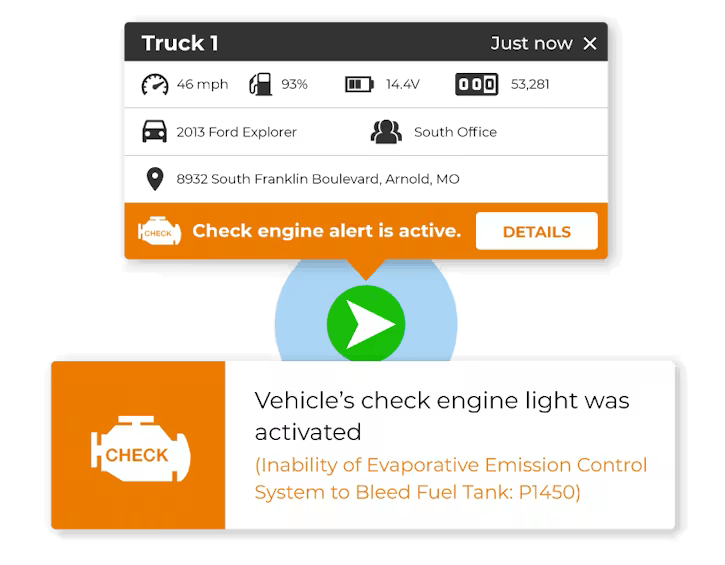
With Linxup Diagnostic Trouble Code Monitoring, you will be alerted to check engine lights when they happen and find the information you need to make maintenance decisions. This feature is automatically available with compatible Linxup devices.
Jason Gerard
Fleet, Finance & Sales Manager, One Hour Air Conditioning & Heating of Baton Rouge
Tracking and monitoring the DTC codes for your vehicles can help you better optimize your fleet and even save money. Learn more here.

Lower break-fix risk and extend the life of your vehicles and assets with maintenance reminders.

Build a strong vehicle maintenance program that helps reduce downtime, extend fleet lifespan, and keep every vehicle running safely.
A DTC is an alphanumeric code your vehicle's onboard computer generates when it detects a problem — it's what triggers the check engine light. The codes are generated by the vehicle's onboard diagnostics system when it detects abnormalities or malfunctions, and provide specific information about the nature and location of the problem. Each of the five characters in a DTC corresponds to a specific part of the issue — the first character is always a letter indicating which vehicle system is affected
It depends on the code, which is exactly why knowing what triggered it matters. Critical codes represent urgent issues that can cause severe vehicle damage — like high engine temperatures or low coolant levels signaling impending engine failure — while non-critical codes don't require immediate action, though they still need attention. Without visibility into the specific code, a driver has no way to tell the difference between a loose gas cap and a serious mechanical issue.
Traditionally, yes — a technician plugs a handheld OBD scanner into the vehicle's diagnostic port to read the code, which means direct access to the vehicle is required. However, with a telematics system in place, a fleet manager can receive real-time alerts anytime a vehicle generates a DTC code — without needing anyone at the vehicle with a scanner.
We're here to help you!