


Quick Breakdown
- Fleet compliance is the ongoing process of meeting DOT and FMCSA safety requirements that keeps your business legal, your trucks on the road, and costly downtime off your schedule.
- Staying organized with logs, inspections, and driver records supports fleet safety compliance and vehicle health while helping you avoid fines and failed audits.
- Tools like ELDs, eDVIRs, and GPS monitoring make compliance easier to manage without adding extra work to your day.
If you run a small HVAC or plumbing fleet, fleet compliance might not be the first thing on your mind. But ignoring it can cost you. A single DOT violation can run anywhere from a few hundred to around $100,000, depending on what got flagged.
For a small crew without a lot of cushion, that kind of fine can mean lost jobs, missed deadlines, and real money out the door. Good fleet compliance management helps you stay ahead of penalties and keep trucks moving instead of sitting.
This guide covers what fleet compliance includes, who it applies to, and the steps service fleet owners can take to stay audit-ready.
What is fleet compliance?
Fleet compliance means keeping your vehicles, drivers, and records in line with the rules set by the Federal Motor Carrier Safety Administration (FMCSA) and the Department of Transportation (DOT). That covers a lot of ground:
- Driver qualifications
- Hours of service (HOS) rules
- Maintenance records
- Vehicle inspections
- Drug and alcohol testing programs
- Licensing, permits, and insurance coverage
Fleet compliance is a legal requirement for any business running commercial vehicles. Fall behind, and you're looking at fines, failed inspections, higher insurance costs, or trucks getting pulled off the road.
A clear fleet compliance management procedure makes it easier to stay on top of driver qualification files, HOS limits, inspection schedules, and recordkeeping before small gaps turn into expensive problems.
Why does fleet compliance matter?
Fleet safety compliance keeps your business out of trouble and your trucks earning. Here's what's on the line if you let things slip:
- Legal and financial protection: Violations can bring fines, suspensions, and, in serious cases, a Revocation of Authority, which is an FMCSA order that shuts you down permanently. Staying compliant keeps you on the road and in business.
- Employee safety and risk mitigation: A solid compliance routine reduces the chance that your drivers get flagged for behavior violations. It's also the foundation of a good fleet safety program.
- Fleet efficiency: Regular vehicle check-ups and solid maintenance records keep trucks moving. DOT fleet compliance and vehicle health go hand in hand.
Employer brand: A clean safety record shows you run a tight operation. That helps with hiring, retention, and winning contracts from customers who check before they sign
Who must comply with DOT and FMCSA standards?
If you operate as a commercial motor carrier, FMCSA standards apply to you. DOT fleet compliance requirements kick in when you run a commercial motor vehicle (CMV) in interstate commerce, meaning you're crossing state lines or supporting work that does.
A CMV includes vehicles that:
- Have a gross vehicle weight rating (GVWR) of 10,001 pounds or more
- Are a single or multi-trailer vehicle with a GVWR of 26,001 pounds or more
- Are designed or used to transport more than 8 passengers (including the driver) for compensation, or more than 15 passengers if not for compensation
- Transport hazardous materials requiring federal placarding, regardless of size
If you're running a local plumbing or pest control fleet, you may be clear on the weight and interstate requirements. But your drivers likely haul corrosives or pesticides. Check the DOT's hazardous materials checklist to confirm what applies to your operation.
6 core pillars of fleet compliance
Fleet compliance comes down to a few core areas, such as HOS rules, driver qualification files, and drug and alcohol testing. Get these right, and the rest gets a lot easier to manage.
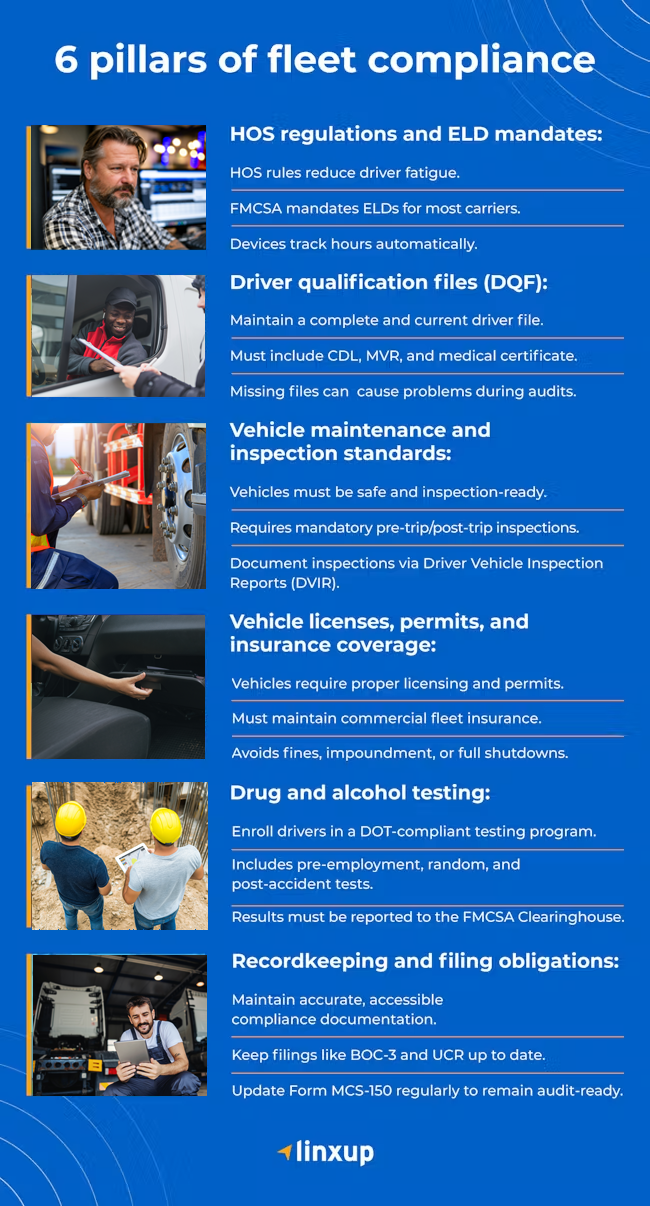
1. HOS regulations and ELD mandates
HOS rules are built to reduce fatigue and keep drivers alert on the road. Most property-carrying drivers must follow these FMSCA limits:
| Rule | Property-carrying drivers | Passenger-carrying drivers |
| Driving limit | 11 hours after 10 consecutive hours off duty | 10 hours after eight consecutive hours off duty |
| On-duty window | 14 hours (does not pause for off-duty time) | 15 hours (off-duty time not included) |
| Break requirement | 30-minute break after eight cumulative hours of driving | Not required under federal HOS rules |
| Weekly limit | 60/70 hours in 7/8 days, with an optional 34-hour restart | 60/70 hours in 7/8 days |
| Sleeper berth | Split 10 hours (min. seven hours in berth + two additional hours) | Split eight hours (minimum two-hour segments) |
| Adverse conditions | Extend the driving and duty window by up to two hours | Extend the driving and duty window by up to two hours |
| Short-haul exception | 150 air-mile radius, return within 14 hours | 150 air-mile radius, return within 14 hours |
The FMCSA also requires electronic logging devices (ELDs) for many interstate commerce, commercial truck, chemical transport, and bus drivers to track these hours. Some small fleets may still qualify for exemptions, like the short-haul exception, but many fleets are now fully digital. Smaller vans, like those used in pest control or HVAC fleets, don’t need one.
ELDs replace paper logs, which cuts down on errors and makes roadside inspections faster. That's one of the main benefits of ELD compliance software: fewer surprises when it counts
2. Driver qualification files (DQF)
Every driver needs a complete, current file. Missing paperwork can lead to violations, fines, or failed audits.
A compliant driver file should include:
- Employment application and work history
- Commercial driver’s license (CDL)
- Driving records
- Training certifications
- Medical certificate
- Motor vehicle record (MVR)
Using driver qualification file management software can help keep everything organized and up to date. Because if a license or medical card expires, that driver should not be on the road, and getting caught can lead to fines or worse.
| Good to know: You must run an annual MVR check for each driver and keep records for three years. Failing to do so can result in recordkeeping violations, with penalties of up to $1,584 per day, capped at $15,846 per violation, and may negatively impact your safety rating during an audit. |
3. Vehicle maintenance and inspection standards
Your vehicles need to be safe, documented, and ready for inspection at any time. That starts with a driver vehicle inspection report (DVIR).
Drivers are expected to:
- Complete pre-trip and post-trip inspections
- Report any defects or safety issues
- Confirm repairs before the vehicle goes back into service
- Document findings in a DVIR
- Sign off on the DVIR to confirm accuracy
- Review the previous DVIR before starting a trip
- Verify that the listed defects were repaired or noted as safe
- Keep a copy of the DVIR in the vehicle when required
- Immediately flag any out-of-service conditions, such as brakes, tires, lights, and steering
Every vehicle also needs to pass a yearly DOT inspection with documentation on file. When something breaks midweek, having a repair record matters. Auditors check for it during roadside inspections, and missing records get flagged fast.
4. Vehicle licenses, permits, and insurance coverage
Every vehicle in your fleet must be properly licensed, permitted for its type of work, and covered by commercial fleet insurance. That includes operating authority, registration, and any permits tied to your routes or cargo.
If something is missing or expired, the consequences can escalate fast, leading to fines, impoundment, or even a full shutdown. It’s one of the fastest ways for a small business to lose money and time.
5. Drug and alcohol testing
Every driver must be enrolled in a DOT-compliant drug and alcohol testing program. That includes pre-employment, random, and post-accident testing.
Results must be reported through the FMCSA Drug and Alcohol Clearinghouse portal. Skipping this step opens you up to serious penalties and liability.
6. Recordkeeping and filing obligations
Good records keep you audit-ready. Bad records invite problems. Carriers have to maintain accurate, accessible documentation across all compliance areas.
That includes filings like:
- Form BOC-3: It's a filing that designates legal representatives in each state who can receive court documents on your behalf if your business is involved in a legal case.
- Unified Carrier Registration (UCR): UCR is an annual registration that allows carriers operating across state lines to stay compliant, based on fleet size. It helps fund state safety programs.
- Form MCS-150: It's your official carrier profile with the FMCSA, including business details, fleet size, and operation type. MCS-150 must be updated regularly to keep your USDOT number active.
Keeping these updated helps you track key fleet management KPIs and avoid compliance gaps. When everything is organized, inspections go more smoothly, and your business keeps growing without setbacks.
9 best practices for managing fleet compliance
A few consistent habits (like setting clear safety standards and running quarterly mock audits) can keep your team organized and your trucks moving.
Here are some ways to stay on track:
- Build a culture around safety and compliance: Make compliance part of how your team works every day. When drivers and managers understand the rules and why they matter, they’re more likely to follow through without reminders. It also creates shared ownership.
- Give drivers a simple daily checklist: Keep tasks clear and easy to follow. Digital tools like eDVIRs and synced data from FMCSA-certified ELD devices can help your drivers log inspections, hours, and issues without juggling paperwork.
- Set clear safety standards: Define what “road-ready” looks like for every vehicle and stick to it. Scheduled maintenance, paired with automated alerts for service intervals or expiring documents, helps prevent surprise breakdowns or compliance gaps.
- Track fleet management KPIs: Monitor trends like inspection results, violations, and downtime to spot issues early. Strong visibility into these numbers supports better fleet visibility and accountability across your operations.
- Store everything in one system: Scattered records slow you down during audits. A centralized platform keeps driver files, inspection reports, and maintenance logs in one place, making it easier to stay organized and respond quickly when needed.
- Use telematics to monitor driver behavior: You can use telematics and GPS fleet tracking to get real-time insight into speed, braking, and route activity. That data helps you coach drivers, reduce risky behavior, and stay aligned with compliance standards.
- Set monthly management check-ins: Create a simple monthly task list for managers — review driver logs, check for upcoming license or medical expirations, and confirm records are up to date. Small check-ins prevent bigger issues later.
- Run quarterly mock audits: Don’t wait for a real audit to find gaps. Internal reviews help you catch missing documents or outdated records early, so you can fix them before they turn into violations.
- Prepare for CVSA International Roadcheck: This annual inspection puts fleets under a microscope. In 2025, it put 18.1% of vehicles and 5.9% of drivers out of service. Being prepared with clean records and well-maintained vehicles helps you pass without disruption.
Simplify fleet compliance with Linxup
Fleet compliance doesn't have to be a constant scramble. A clear system and consistent habits turn it into something you just stay on top of.
Linxup brings it all together with FMCSA-certified ELD devices, easy-to-use fleet management software, and GPS fleet monitoring. Keep driver logs, inspections, maintenance records, and key filings in one place, without chasing paperwork or second-guessing your data.
Linxup also integrates with Draivn, a telematics-to-insurer platform that connects your fleet safety data directly with insurance partners. That means your compliance record can work for you beyond just passing audits.
Book a free demo to see how Linxup helps small service fleets stay audit-ready without adding extra work to your day.
Book a free demo to simplify compliance and keep your vehicles audit-ready without extra admin work.
Fleet compliance FAQs
What is fleet compliance?
Fleet compliance is the ongoing process of keeping your vehicles, drivers, and records in line with DOT and FMCSA requirements. It covers hours of service, driver qualification files, vehicle inspections, drug and alcohol testing, and recordkeeping. For service fleets, it's not optional: operating outside these rules can result in fines, failed inspections, or trucks being pulled from service.
What are the 5 pillars of fleet management?
Fleet management typically covers five core areas: vehicle maintenance, driver management, route and dispatch efficiency, compliance and safety, and cost control. Fleet safety compliance threads through all of them. When your vehicles are maintained, your drivers are qualified, and your records are current, the other areas get easier to manage too.
How do you become fleet certified?
Fleet certification generally means completing a recognized professional program, such as the Certified Automotive Fleet Manager (CAFM) designation through NAFA Fleet Management Association. For small service fleet owners, certification isn't always required, but having documented compliance processes, up-to-date driver files, and regular audits puts you in a strong position whether a certification is involved or not.
How does a driver become compliant?
A compliant driver has a current CDL, a valid medical certificate, a clean MVR on file, and is enrolled in a DOT-approved drug and alcohol testing program. They know the HOS rules that apply to their routes, log hours correctly in their ELD, and complete pre- and post-trip inspections consistently. Regular check-ins and straightforward training go a long way in keeping drivers compliant as rules or routes change.
What are the main FMCSA regulations for fleets?
The core FMCSA regulations cover HOS rules, driver qualification requirements, vehicle inspection and maintenance standards, drug and alcohol testing, and recordkeeping. You also need to keep your USDOT number and MCS-150 form current.
What are common DOT inspection violations to avoid?
The most common violations are incomplete driver logs, faulty brakes or lights, worn tires, and missing or outdated documentation. Most of them are preventable with consistent inspections, a maintenance schedule, and organized records. Small things get missed when teams are busy. A simple monthly review catches most of them before an inspector does.